“I had a little bird, her name was Enza
I opened up the door and in flew Enza.” — Children’s Rhyme, 1918.
Flu vs. Flu: “TRANIO He is my father, sir; and, sooth to say, In countenance somewhat doth resemble you. BIONDELLO [Aside] As much as an apple doth an oyster, and all one.” –- William Shakespeare, Taming of the Shrew
Hypothesis: Covid19 is NOT the same as seasonal flu
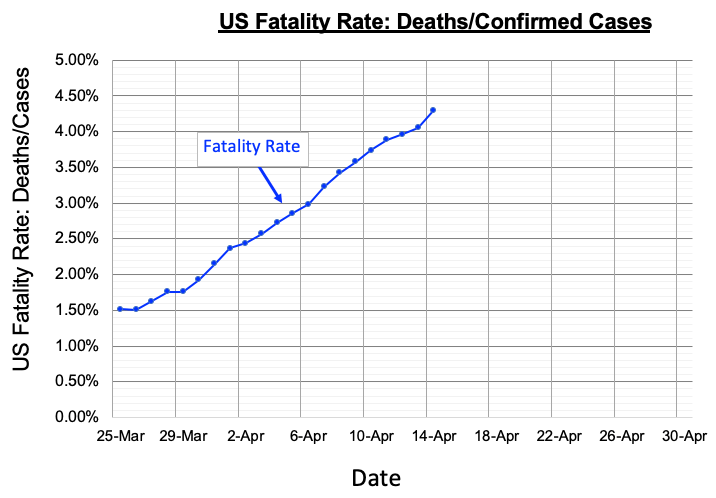
Here is a curve showing fatality rate calculated using the Johns Hopkins database that has been used in nearly all pandispatch posts to date.
For comparison here is some current CDC data on seasonal flu.
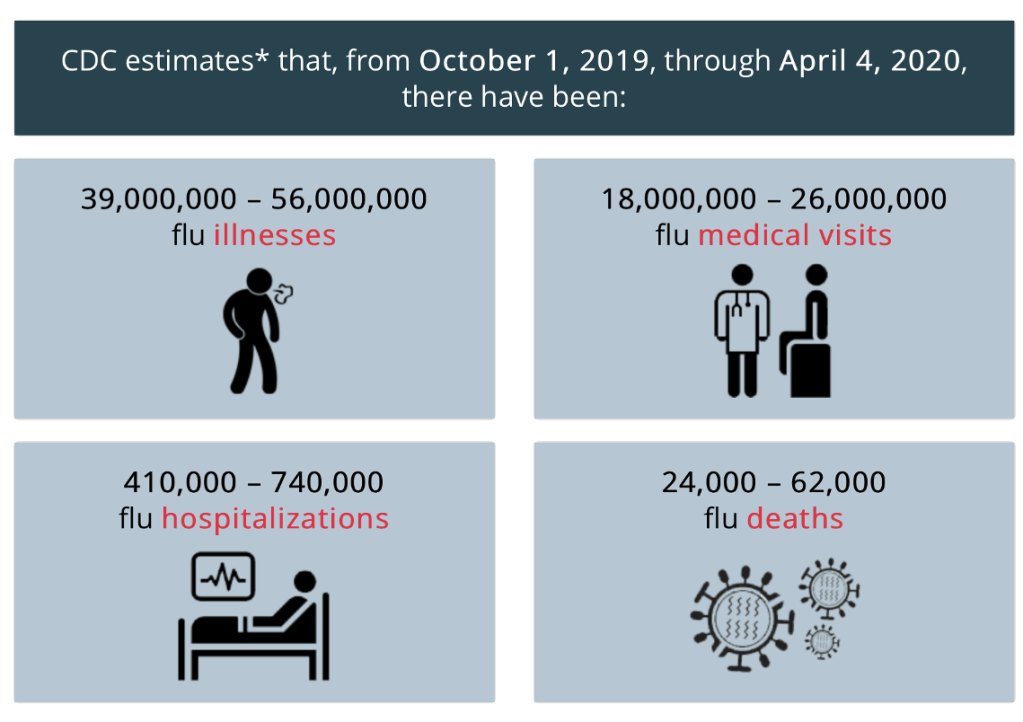
Some calculations using the above data:
Seasonal Flu Fatality Rate (CDC) = 56,000,000 / 62,000 = ~0.1%
Current Covid19 Fatality Rate (from latest value of curve) = ~4.1%
Ratio Covid19 / Seasonal = 40 (4.1% / 0.1%)
This calculation estimates that Covid19 is 40x more “deadly” than seasonal flu. This seems very large. There may be many unconfirmed cases — in which case the denominator used in calculating the fatality rate would be much larger — resulting in a lower rate. On the other hand there are reports that many deaths go unrecorded, which would increase the numerator — resulting in a higher fatality rate. Do these two unknowns cancel each other out? Maybe. And if they don’t, to what extent does one or the other prevail? We don’t know. We don’t have enough data.
Let’s consider a perhaps more reasonable case where the count of deaths is perfect (all correctly reported), but the number of cases is under-reported by, say, a factor of 4. In other words there are actually 4 times more cases than the number reported. In this case the fatality rate would be adjusted: 4.1% / 4 = 1.025%. The comparison with seasonal flu would then be 1.025% / 0.1% = 10.25. We see that even in this more “reasonable” case Covid19 causes over 10 times the number of deaths than seasonal flu. If we use the 1.025% rate and maximum seasonal flu deaths we get 10 x 62,000 = 620,000 which, when all is said and done (say late 2021), could be closer to the actual total recorded.
From this we might claim that Covid19 is NOT the same as seasonal flu. The fact that at the moment there are fewer Covid19 deaths than seasonal flu deaths ignores the impact of social distancing and other mitigation measures. If we were to impose similar measures during the regular flu season we would likely see an equally dramatic number of deaths.
Caveat: Available case and fatality data is still very limited and may very easily be less than valid. As time goes on the data could change; for example with better reporting. In addition a direct ratio of fatalities/cases, as used above, should be adjusted for the “lag” of fatality count vs. case count. In this case it would actually increase fatality rate. We also see from the curve that the fatality rate appears to be increasing over time. Why? How does this play in? Is this just an artifact of insufficient and/or incorrect data? We need more data to obtain a more accurate estimate as the curves plateau.
What all this weasel-wording is meant to say is that current Covid19 fatality rates, computed using very rough estimates, appear to be much larger than seasonal flu at this time. As mentioned countless times in this and previous posts — we simply need more data to firmly prove the hypothesis.
… On the other hand we could just ignore all of this guessing estimating and defer to authority with the likes of professional modelers (UW IMHE, Penn CHIME, Johns Hopkins) and experts like Fauci and Birx who have estimated up to 2 million US deaths if no mitigation measures are deployed. Large numbers like these appear to unequivocally place Covid19 in a class of its own.
In conclusion I will state the obvious: The above attempt to characterize Covid19 exemplifies the current state of affairs in trying to understand the pandemic. The nonlinear combination of rapidly changing real world factors influencing data validity at this time of great flux seriously impedes attempts at development of solid statistical and theoretical underpinnings on which to base high confidence predictions.
In other words, we don’t know enough — yet — to say what’s gonna happen.
 RoboSapiens — AI: Artificial Intelligence and Our Future