Originally published 13-Mar-2020
Here’s an update to the Covid-19 table shown in the previous post.
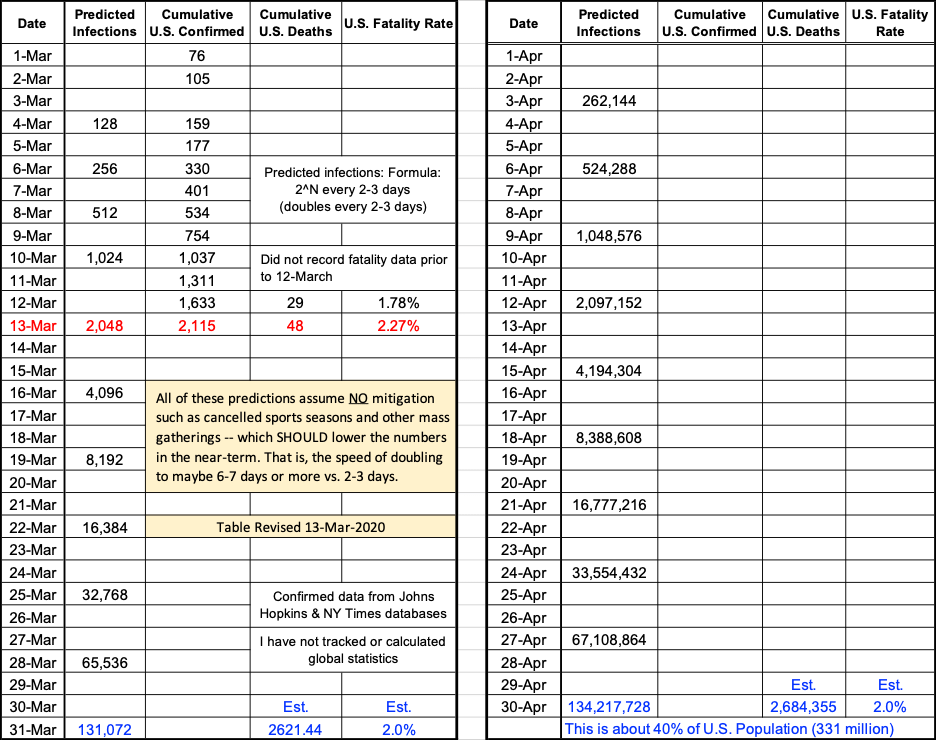
Yeah, the numbers are growing and seem to match predicted values (so far). This revised data actually shows an increased doubling-rate when compared the previous table (post #2). However, as noted in the table, these statistics do NOT include any mitigation measures such as cancelled sports seasons, closed schools, closed theaters etc., to say nothing of people just staying home. Hopefully these measure will help to significantly reduce the rate of growth – which would lower the demand on healthcare resource, which in turn should reduce the number of deaths. On the other hand — a reduced rate does not mean that the virus spread will not result in the same total number of cases and fatalities. We can still expect 20% – 40% (60 – 100 million) people to get the disease – just at a more leisurely pace, say over a period of years.
Shocking! Where do we hide? (Probably nowhere).
But there is actually some hope / good news. These very large numbers should be reduced once a vaccine becomes available in 12-18 months. So it is not unreasonable to expect the ultimate number of U.S. infections to be at the low end, say 20 – 40 million. A fatality rate of, say, 2% (current best-estimate is 3.4%), consisting mainly of the elderly, would result in 400,000 – 800,000 U.S. deaths. In comparison the annual flu (fatality rate 0.1% or less) results in 40,000 – 60,000 U.S. deaths. For the global population (approx. 8 billion) the corresponding number of cases would be, on the low end, say 20% x 8 billion = 1.6 billion cases. Number of deaths = 2% x 1.6 billion = 32 million or so. Hard to comprehend, but there it is. The 1918 Spanish flu killed 60 – 100 million people worldwide. We discussed this flu and its differences in spread and treatment relative to Covid-19 in a previous post. There are enough similarities between Covid-19 and Spanish flu that a number like 32 million could occur, or at minimum 10’s of millions. So this is not Ebola or SARS or H1N1. The mechanism of spread and the fatality rates for those diseases differ significantly from Covid-19, which is more similar to Spanish flu.
So how long will this go on? Dr. Fauci today mentioned as few as 8 weeks when he was sort of forced to give an estimate (my guess is that he is thinking much longer but as a scientist is loathe to guess). His hesitation is due to the factors mentioned above – i.e., how quickly can mitigation measures be successfully implemented. Every day counts right now — remember, the number of cases doubles every few days (see the table above). And the duration depends strongly on how effective the measures are. As for testing – it is essentially irrelevant at the moment except insofar as helping to geographically focus healthcare resources. And vaccines will not be available for a year or more despite what you might see in the news from this or that lab / company.
And finally, a bit of bad news. Recall from a previous post that Spanish flu wreaked havoc early in the year, then came back with a vengeance in the Fall – when it claimed the majority of its victims. It only makes sense to wonder if Covid-19 might recur in a similar way, with similar consequences. A key difference might be if, miraculously, a vaccine is created in about half the time it is estimated to take. What are the chances of this happening? 50/50? And what are the chances that the government decides to “rush it to market” even if it’s not fully tested, especially if confronted by large numbers of deaths? Probably high, but with a concomitant risk of making things worse.
There are three other issues that we’ll get into next time – financial/market impacts, healthcare availability (e.g., number of available ICU’s / beds / equipment), and psych-sociological impacts (current and future). These will be addressed in a future post. Right now I hear there’s a bottle of Purell available at a Tuscon Walmart, so… gotta head out…
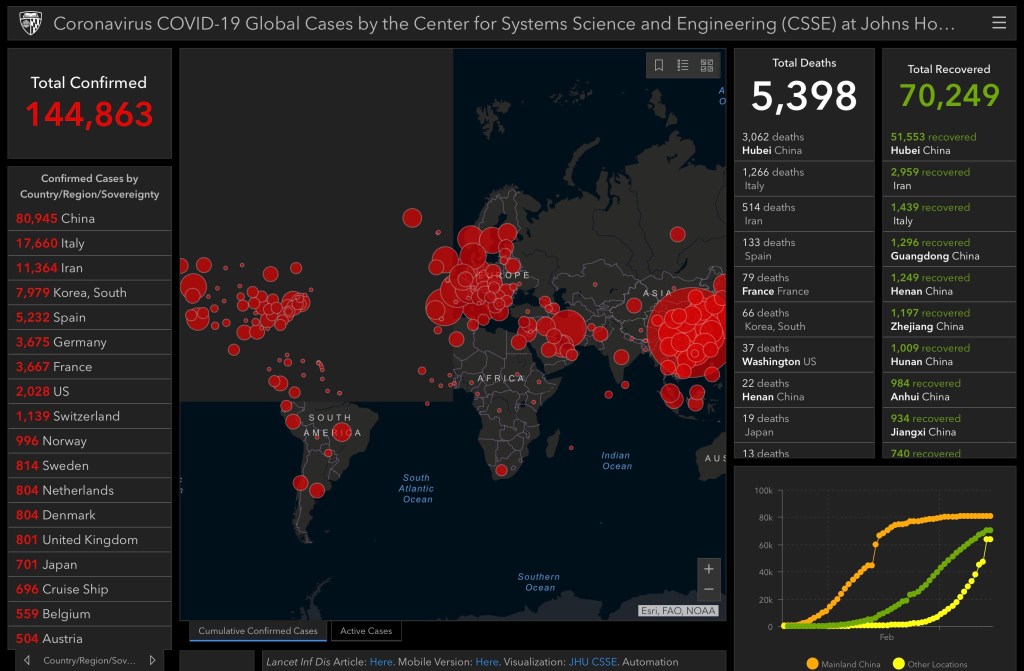
“Dr. Pat” For fun here’s a global map of Covid-19 cases (Johns Hopkins) from earlier today:
 RoboSapiens — AI: Artificial Intelligence and Our Future