
Originally published 12-Mar-2020
The first 4 posts were sent as emails to family and friends starting about March 8. The intent was to try to lend some statistical and reliable information to help them formulate a context for preparation and understanding of what was happening and what was likely to come. My main point was that, based on the data, this things looks real. Now that it is real and a lot of the information in these posts is more broadly available I plan, going forward, to adapt and attempt to provide some level of substantiation to what everyone is hearing.
PatP.S./ My apologies – the table is an image. In future I will try to provide a cut-and-paste version in case someone wants to use the data elsewhere.
Here’s a quick update on the COVID-19 / Coronavirus pandemic.
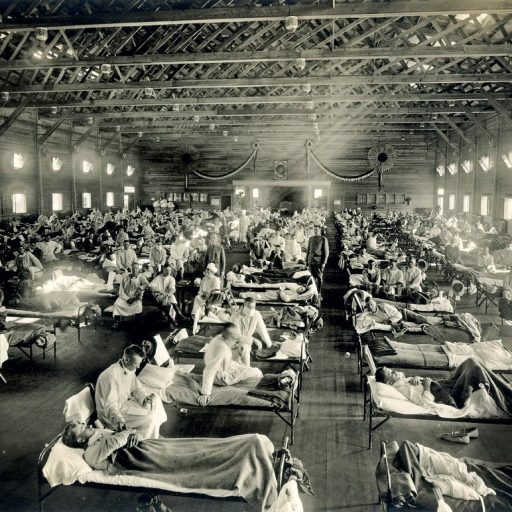
1918 Spanish Flu.
Using the 1,2,4,8… formula I described in my previous post, I drafted the following table showing cases doubling about every 3 days. The formula seems to predict results that match actual data reasonably well. If government mitigation procedures (school closings, no mass gatherings, quarantines) have no effect, the prediction shows more than 60,000 U.S. cases (65,536) by the end of March. This matches the high end of annual flu cases (20,000-60,000). With a fatality rate of 3% (may be much less once a larger number of test results are available), predicted deaths for COVID-19 would be ~1,900 by March 31.
If we extrapolate into April using the same doubling-every-3-days formula we see over 67 million cases by the end of April, with a corresponding 2,000,000 deaths. This is sobering … (no sh*t!).
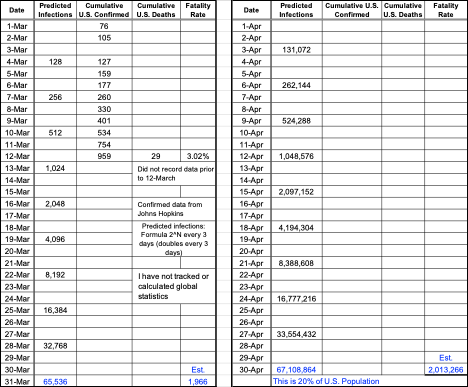
The global death toll for the 1918 Spanish flu is estimated to be 50 million, but might have been as high as 100 million. Between 3% and 5% of the world’s population died. In the United States 675,000 people died. 30% of the population became infected. Experts say that Spanish flu has a number of epidemiological similarities to COVID-19. The 67,108,864 number in the table (April 30) is just 20% of U.S. population of 331 million. A 30% infection rate similar to the Spanish flu would yield U.S. COVID-19 cases of over 100 million. Yeah. I don’t believe it either. But this is what the pattern shows. I would be very happy to be proven wrong…
A couple of things. Hopefully government (Federal, State, Local) intervention will mitigate the pandemic to some extent. It depends on what happens in the next week or so. If enough successful quarantining occurs, it should help flatten the demand on medical resources – enabling more manageable patient loads and reducing the number of cases and deaths. If these efforts are less than successful, then see photo above.
So, now what…? Before we all head for the hills we should consider a few things. First, current statistics show that if you’re younger than 60 your risk of serious illness is minimal. However, you can still be a carrier and infect some of us “old folks.” Second, health care has progressed significantly in the last 100 years, so the ability to treat you should be much improved. On the other hand the current fatality rate estimate is 1% – 3% (current number floating around is 3.4%), so modern health care may not be having a significant effect. And third, communication has improved (1918 = mostly vacuum tube radios), enabling rapid communication among the populace and supporting health-care support logistics beyond anything imagined in 1918. This may prove to be the most crucial advance and may significantly reduce all of these scary numbers. Finally, draconian quarantining like that imposed in China would likely help, but won’t/can’t be practiced here, unless a National Emergency is declared and troops called up. Also keep in mind that statistics coming out of China should be viewed with a (large) dash of skepticism.
Feel free to forward this blog link and to anyone you think might be interested. And remember this is just data. I have tried to remain as objective as possible — in the end, data, like the virus and nature, don’t care about politics or the economy, etc.
Pat
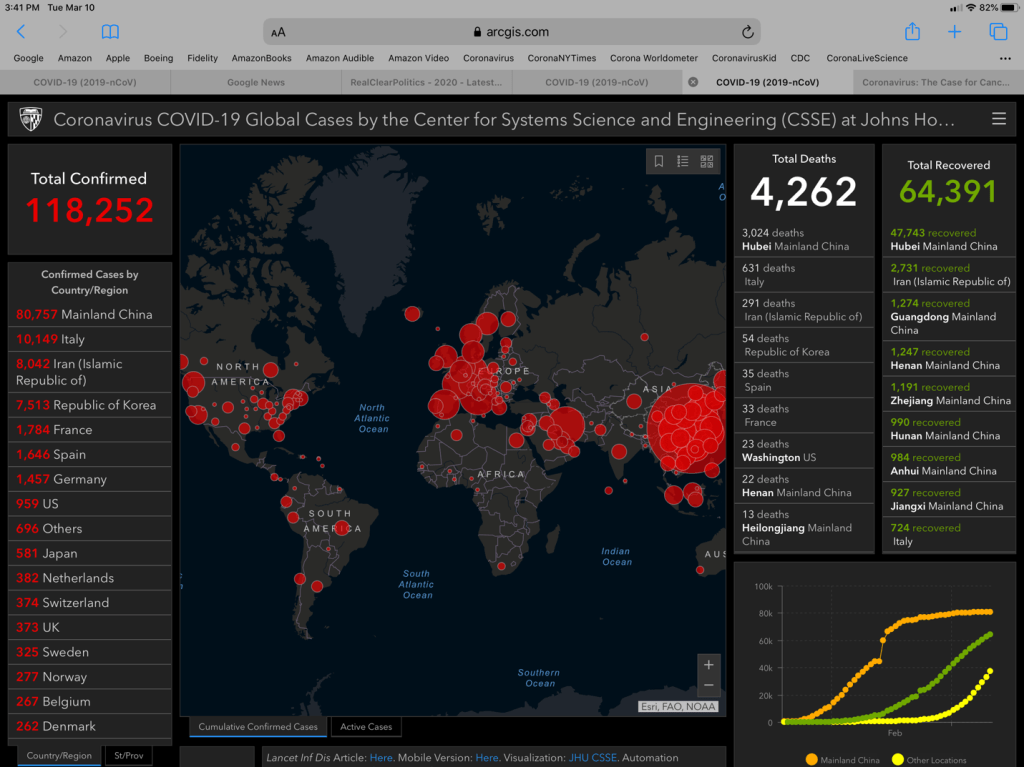
— Here’s a snapshot of global virus-spread today (10-March-2020, from Johns Hopkins):
 RoboSapiens — AI: Artificial Intelligence and Our Future